


[ad_1]
Vivek Ramaswamy won the Republican Primary for the Ohio governor race, but prediction markets still favor Democrat Amy Acton.
The Ohio governor race is officially set between Vivek Ramaswamy and Amy Acton, and prediction markets show the contest as essentially a toss-up with a slight Democratic lean.
Republicans have a stronghold on statewide offices in Ohio, and Democrats haven’t held the governor’s mansion in two decades. Still, prediction markets appear to like Acton’s chances against Ramaswamy, despite his backing from President Donald Trump.
Both Kalshi and Polymarket are showing the Democrats are favored to win the office after Ramaswamy secured the nomination in Tuesday’s Republican primary. It echoes similar vibes from traders on the Ohio Senate special election race, where markets are favoring Democrat Sherrod Brown in what would be a key pickup for control of the Senate.
Ramaswamy clears the GOP field
Ramaswamy, a biotech entrepreneur and former GOP presidential candidate, easily won the Republican nomination after a primary in which Trump’s endorsement mattered a lot. Now, multiple media outlets describe the win as setting up a competitive 2026 midterm race.
The broader frame is that he enters the general with a big profile, a large war chest and Trump’s backing. However, he also has vulnerabilities tied to his outsider image and policy pivots.
With Tuesday’s victory, Ramaswamy is officially the face of a Republican ticket in an entrenched GOP state.
Acton gets a clean lane
Acton was uncontested for the Democratic nomination. That gives her the rare advantage of spending the spring building a general election case rather than surviving a primary.
She does have some credibility with establishment Republicans as well, as outgoing Gov. Mike DeWine appointed her as the state health director in 2019. That term, however, did include her response to the COVID-19 pandemic, which opponents have used in campaigns against her.
Acton already framed the race around affordability, Medicaid, prescription drug costs, and working family economics. Those line up neatly with the concern in the polling data that cost-of-living issues are biting in Ohio.
That cleaner lane helps explain why the market is not giving Ramaswamy a strong early edge despite Ohio’s Republican history. He’s an outsider nominee who has to define himself statewide against a well-known public health figure.
Prediction markets versus Ohio governor polls
The polling picture is still fluid, but it does not show a runaway for either side. The New York Times polling tracker reflects a genuinely neck-and-neck race. Recent surveys suggest the matchup is closer than Ohio’s partisan baseline might suggest.
That is tighter than the prediction markets, where the race leans blue but is still tight enough that anything can still happen. Kalshi’s Ohio Governor Winner market now defines the candidates by name, with Acton leading with a 55% chance on $251K in volume.
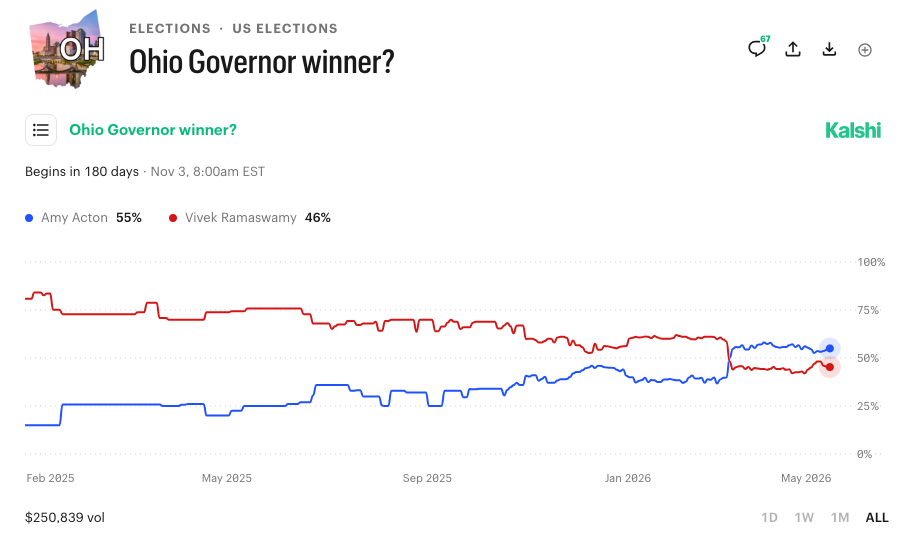
Polymarket’s Ohio Governor Election Winner contract still lists just parties, with Democrats at 53% and Republicans at 47%. Traders have not funneled much money into the Polymarket contract yet, sitting at $87K in volume.
Why Ohio governor race is interesting
The Ohio race is useful because it shows how prediction markets respond to candidate quality, not just party labels. Ramaswamy is the GOP’s nominee, but Acton is not a weak opponent. The markets are giving her enough credit to have an edge in a near toss-up.
Traders appear to be factoring in candidate-specific signals like profile, favorability, and issue fit, not just the usual red state arithmetic.
It also gives Democrats a plausible path in a state that is normally strongly red. If the early race holds and the polls continue to show a narrow gap, Ohio could become one of the cycle’s signature market-vs-poll contests.
Prediction markets are not buying Ohio as a GOP coronation just because Ramaswamy won the primary. Instead, traders are pricing this as a test of whether Trump-backed celebrity candidates can convert primary energy into statewide wins, or whether a disciplined Democrat can turn an open-seat race into a surprise.

Pat Evans
Pat Evans has nearly two decades of experience covering complex industries. Before joining Defi Rate in 2026, he spent more than 15 years writing about sports betting, food and beverage, construction, health care and sports business for national and regional outlets. He previously worked as a reporter and editor for publications including the Grand Rapids Business Journal, Front Office Sports, Legal Sports Report and iGaming Business, where he began in-depth reporting on prediction markets. Pat holds a political science degree from Michigan State University.
[ad_2]
Source link