Intro
With The Shanghai/Capella improve quickly approaching, there's quite a lot of dialogue about Ethereum Staking Withdrawals and what this implies for the Ethereum ecosystem as a complete.
So how do withdrawals work? What are widespread misconceptions about this course of? And what are the implications of enabling Ethereum stakers to withdraw their locked-up ETH? You’ll discover solutions to those questions and extra on this article.
The Beacon Chain
Let’s begin with understanding how we bought right here and why staking withdrawals weren’t enabled when Ethereum moved from proof-of-work to proof-of-stake.
The transition to PoS occurred over a number of steps to minimise the variety of large modifications occurring on the identical time. This method was important, particularly for a longtime community settling trillions of {dollars} of worth per yr.
Probably the most vital steps have been:
-the launch of the Beacon Chain
-the Merge
The launch of the Beacon Chain in 2020 created the muse for the transition by making a separate PoS consensus layer, operating alongside the Ethereum PoW chain.
Launching the Beacon Chain earlier allowed for the buildup of sufficient ETH to safe the community earlier than settling real-value transactions. It additionally allowed the testing of the brand new PoS consensus mannequin for an prolonged interval with actual funds at stake.
The early community contributors dedicated thousands and thousands of ETH to safe the Ethereum PoS community regardless of figuring out they wouldn’t be capable to withdraw their ETH till a lot later.
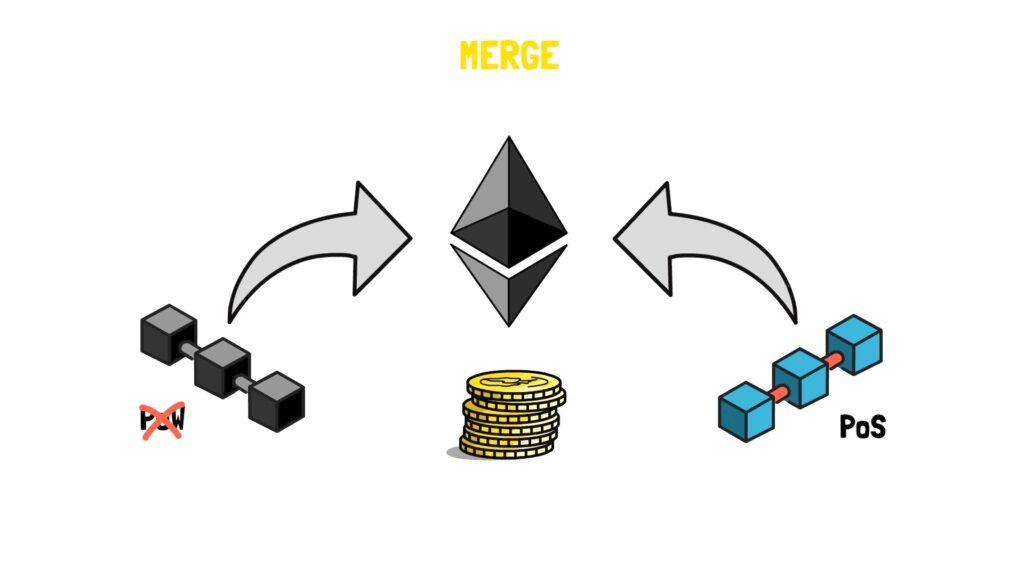
The following large step, the Merge, united the PoS consensus layer with the execution layer. This allowed for lastly shifting off PoW and sustaining just one canonical chain – Ethereum – now secured by thousands and thousands of staked ETH.
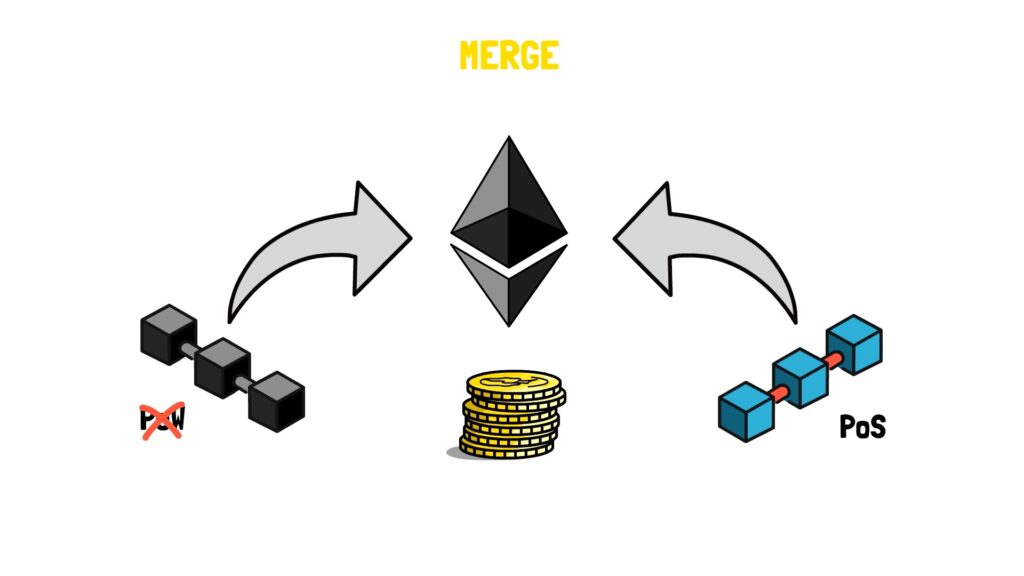
The Merge was by far the most important change ever to Ethereum. As a result of nature of the improve, It needed to occur with none downtime.
To minimise threat, the scope of The Merge was diminished, and no different options, outdoors of the PoW to PoS change, have been included as a part of the improve.
The largest “minimize” that needed to be finished impacted withdrawals, which turned the main focus of the upcoming Shanghai/Capella improve.
Withdrawals
Staking withdrawals, because the title suggests, will enable stakers to withdraw their locked-up ETH.
Earlier than we get any additional, let’s outline two sorts of withdrawals: “partial” and “full”.
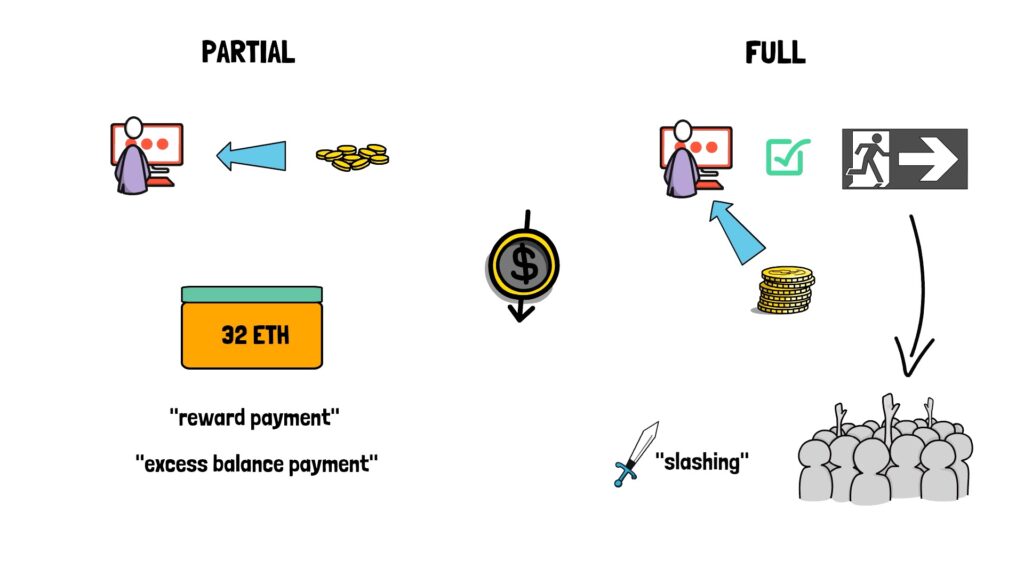
A “partial” withdrawal occurs when the validator withdraws their gathered rewards. That is an additional steadiness on prime of the utmost efficient steadiness of 32 ETH. A “partial” withdrawal will also be known as a “reward cost” or “extra steadiness cost”.
In distinction, a “full” withdrawal occurs when the validator has accomplished the method of exiting, and your entire steadiness is withdrawn. This happens solely when the validator exits the system both voluntarily or by being forcibly eliminated in a course of referred to as “slashing”.
As soon as enabled, staking withdrawals shall be robotically distributed each few days. We’ll clarify the small print of this course of later.
Moreover, the withdrawal course of initiates on the consensus layer, so no transaction payment is required at any of the steps.
With a view to begin withdrawing their staking rewards, a validator must present their withdrawal handle solely as soon as.
Given withdrawals have an effect on each the consensus and execution layers of Ethereum, each components of the community have to be up to date. Shanghai is the title of the execution layer improve containing withdrawals, that are laid out in EIP-4895, and Capella is the title of the counterpart consensus layer improve, which shall be activated on the identical time.
These two upgrades are typically additionally known as Shapella.
Now, let’s see how withdrawals work below the hood.
Mechanics
Within the Ethereum ecosystem, every validator has a corresponding index quantity. As well as, additionally they have two sorts of withdrawal credentials outlined as both 0x00 or 0x01.
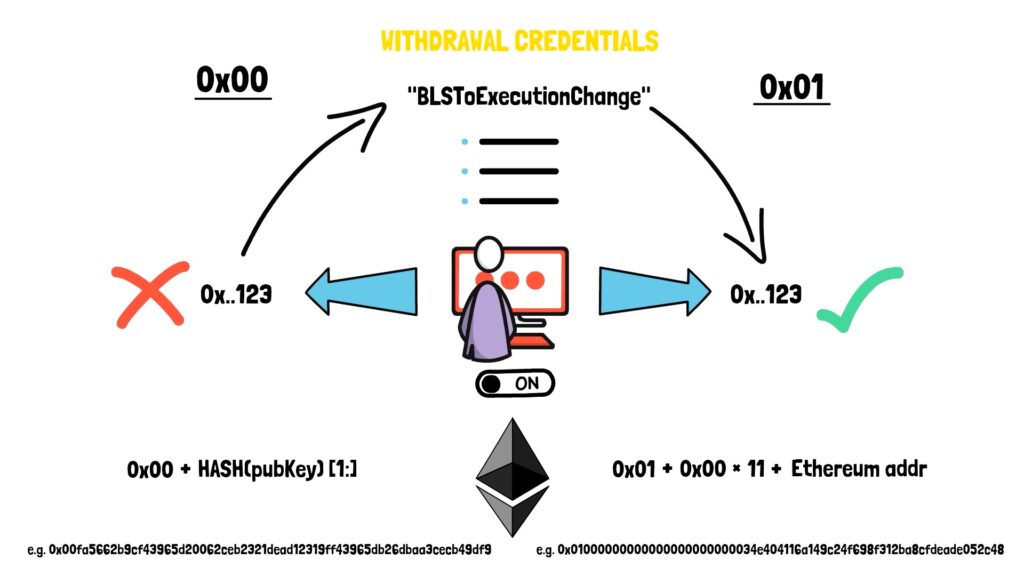
0x00 signifies {that a} specific validator doesn’t have an related withdrawal handle. These credentials are derived because the hash of the BLS public key with its first byte swapped out with a zero byte therefore the title.
In distinction, 0x01 signifies that a validator supplied their withdrawal handle. These withdrawal credentials are represented as 0x01 adopted by 11 bytes of zeros, then a selected Ethereum handle.
With a view to allow withdrawals, validators with 0x00 credentials might want to signal a “BLSToExecutionChange” message. This shall be attainable after the Capella improve.
As soon as withdrawals are enabled, a validator proposing a block will scan linearly by validator indices to seek out the primary 16 validators with 0x01 credentials who both:
-have a steadiness that exceeds 32 ETH (accrued validator rewards)
-are “withdrawable” (have absolutely exited validator set)
The linear search stops after both discovering 16 validators to match these standards or after 16,384 iterations. The algorithm remembers the index at which the search stopped, so the following validator proposing a block can resume from that index. After attending to the final index, the algorithm begins from the start – index 0.
analogy right here could be an analogue clock the place the hand on the clock factors to the hour, progresses in a single path, doesn’t skip any hours, and ultimately wraps round to the start once more after the final quantity is reached.
After the scan is accomplished, the validator creates a listing of withdrawals to be included of their execution payload.
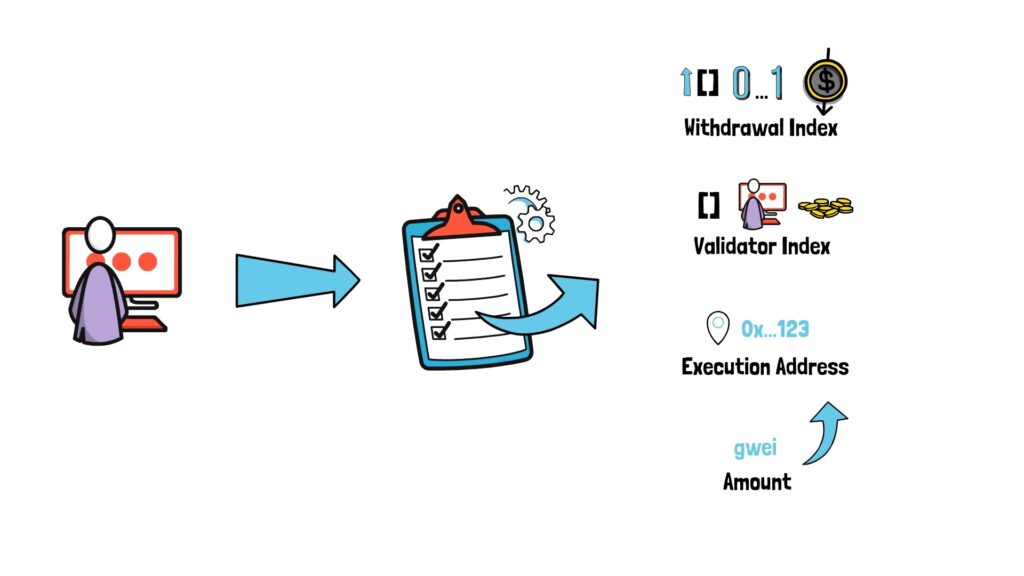
Every merchandise on the checklist accommodates the next:
- “WithdrawalIndex” – a monotonically growing index, ranging from 0, that increments by 1 per withdrawal to uniquely determine every withdrawal
- “ValidatorIndex” – the index of the validator whose steadiness is being withdrawn
- “ExecutionAddress” – the ETH handle on the execution layer the place the withdrawal needs to be despatched
- “Quantity” – the quantity, in gwei, to be despatched to “ExecutionAddress”
When constructing or processing a block, Execution Layer purchasers will apply these withdrawals on the finish of a block. As talked about earlier, processing withdrawals don't compete with person transactions for block area.
With a most of 16 withdrawals that may be processed in a single block, there needs to be a most of 115,200 withdrawals processed per day (assuming no missed slots).
As we are able to see, the design of withdrawals is straightforward but extraordinarily strong.
Now, it’s time to debate some widespread misconceptions in the case of withdrawals.
Misconceptions
The primary false impression states that, when processing withdrawals, there's a distinction between a “full” and a “partial” withdrawal when it comes to precedence or ordering.
Each “full” and “partial” withdrawals occur when the linear scan over the validator set reaches a validator’s index. The one distinction is that within the case of “full withdrawals”, a validator should go away the exit queue and attain the “withdrawable_epoch” earlier than the linear scan can choose it up.
One other false impression is that customers will lose their rewards if they don't present a withdrawal handle which isn't true. In case a validator forgets to offer a withdrawal handle, their ETH rewards won't be despatched to the void as soon as withdrawals are enabled. As an alternative, the scan will skip validators who haven’t supplied their withdrawal addresses.
Additionally, it’s vital to keep in mind that the withdrawal handle can't be modified, and it’s set solely as soon as. Subsequently, stakers have to be extraordinarily cautious when organising the withdrawal handle, guaranteeing they've full possession of the handle supplied.
There's additionally quite a lot of hypothesis in the case of withdrawals. One price mentioning is the idea that stakers will withdraw quite a lot of ETH from the Ethereum ecosystem as soon as the withdrawals are enabled. The stronger model of this argument additionally assumes that this can destabilise the PoS consensus mechanism.
Though we can not absolutely predict how a lot ETH shall be withdrawn over time, there are just a few vital counterarguments.
First, most stakers are early Ethereum adopters who have been courageous sufficient to stake when it was nonetheless unsure when the withdrawals could be enabled. Many stakers have expressed their want to proceed staking to help the community and to proceed incomes ETH-denominated rewards.
Secondly, to make sure that the PoS consensus mechanism and the energetic set of validators stay secure, Ethereum carried out a withdrawal queue for all validators wishing to exit. This queue limits the variety of validators that may go away the ecosystem concurrently.
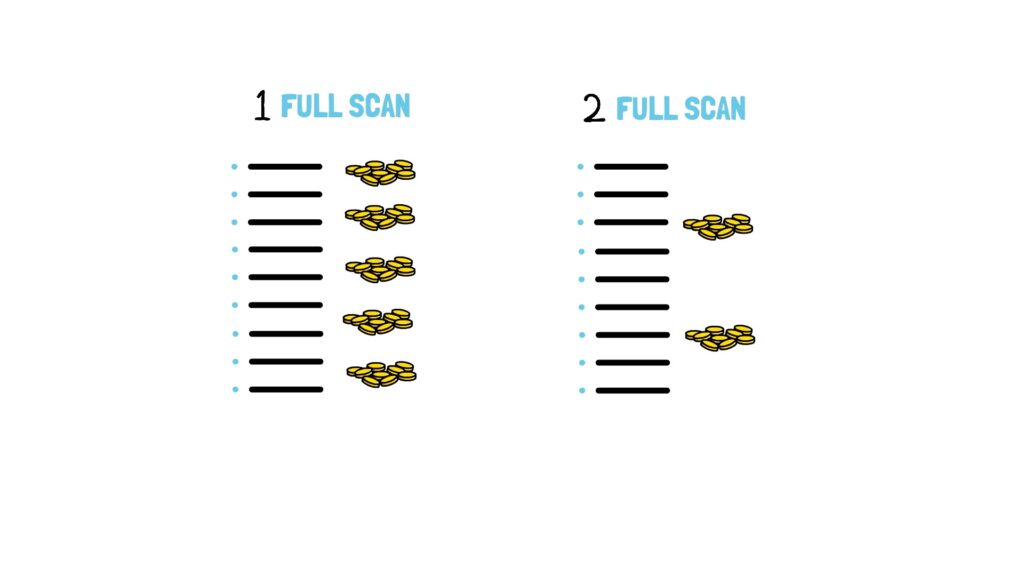
It’s price mentioning that the primary withdrawal scan will withdraw quite a lot of gathered rewards – mainly because the inception of the Beacon Chain. Nonetheless, the following ones will course of a a lot smaller quantity of ETH.
There are additionally some vital implications in the case of withdrawals.
Implications
First, enabling withdrawals will create an open, two-sided staking move.
At present, the staking move is one-sided; ETH can solely move into the community and by no means exit it.
Curiously, enabling withdrawals might incentivise much more individuals to stake as they'll know they will all the time withdraw their ETH if wanted for one thing else.
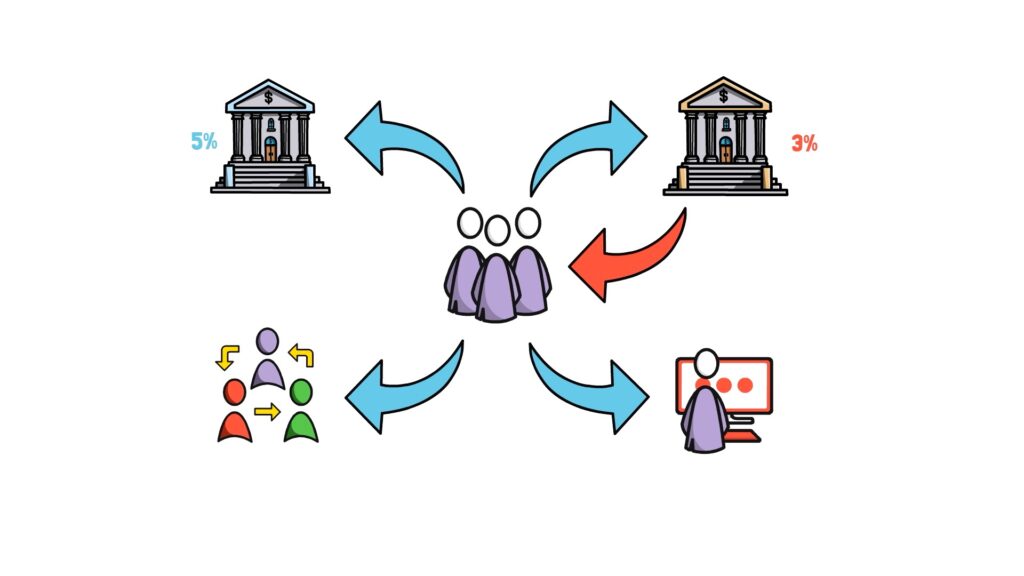
Stakers who don’t run their validators and stake with a centralised staking supplier will be capable to change their supplier to a distinct one. So, for instance, they will withdraw their funds from a supplier that gives a decrease staking fee to a different supplier which presents a greater fee or transfer from a centralised supplier to a decentralised one, and even run their very own validator!
Withdrawals will even impression liquid staking derivatives resembling Lido, RocketPool and others. For instance, liquid staking cash resembling stETH or rETH had a historical past of briefly shedding their peg to the worth of ETH throughout market turbulences. Nonetheless, with the two-sided staking move, any vital discrepancy of their peg could be rapidly arbitraged away.
Early adopters in liquid staking and centralised staking captured a overwhelming majority of the market as they didn’t have a lot competitors. Nonetheless, the market share of those incumbent gamers might see a significant change as soon as withdrawals are enabled, particularly in the event that they don’t provide a aggressive fee.
The power to shift freely between staking suppliers will profit the ETH staking market.
Abstract
Enabling staking withdrawals is among the most anticipated upgrades to Ethereum.
Will probably be extraordinarily vital to verify this modification is executed easily. With a view to assist with testing, validators may have a number of devnets and testnets accessible to run by the method and iron out any potential points earlier than going reside on the mainnet.
Withdrawals are yet one more enchancment bringing Ethereum one step additional in direction of constructing a sustainable, safe and decentralised future.
Shapella improve is anticipated to happen within the first half of 2023.
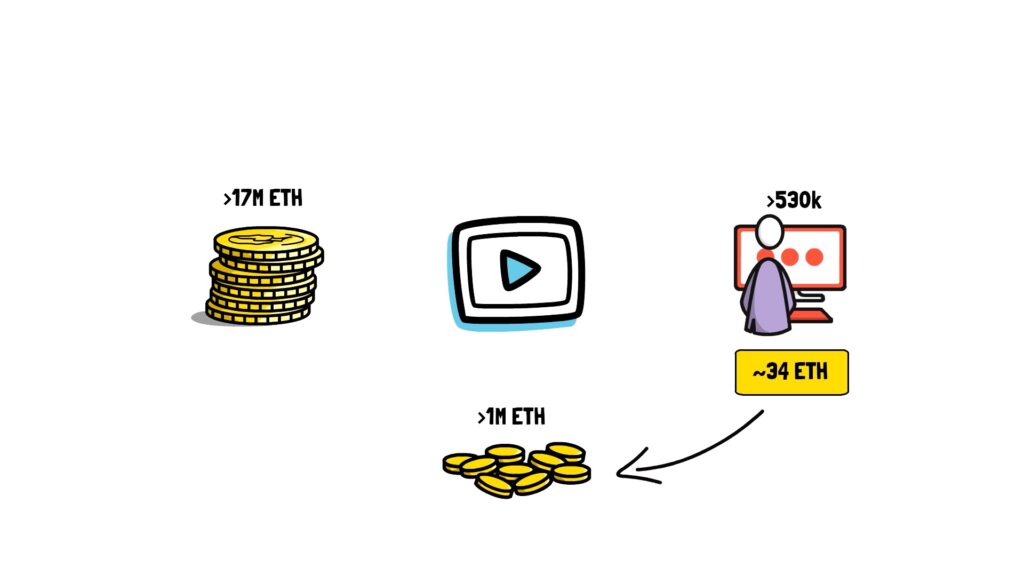
On the time of writing this text, The Beacon Chain gathered over 17M ETH throughout over 530k validators. A median steadiness for a validator is simply above 34 ETH, which implies over 1m ETH in gathered rewards. Will probably be attention-grabbing to see how withdrawals will have an effect on these numbers.
So what do you concentrate on Ethereum enabling staking withdrawals? Remark down under.
For those who loved studying this text, test Finematics on Youtube and Twitter.