Unlock the Editor’s Digest free of charge
Roula Khalaf, Editor of the FT, selects her favorite tales on this weekly publication.
It has taken 17 years, important funding, a string of false dawns and a number of damaged guarantees however lastly one of many key improvements to come up from the period of the good monetary disaster has accomplished one thing helpful: my son made dinner final evening. (I used to be out, however I collect it was a fairly first rate effort at cream of tomato soup.)
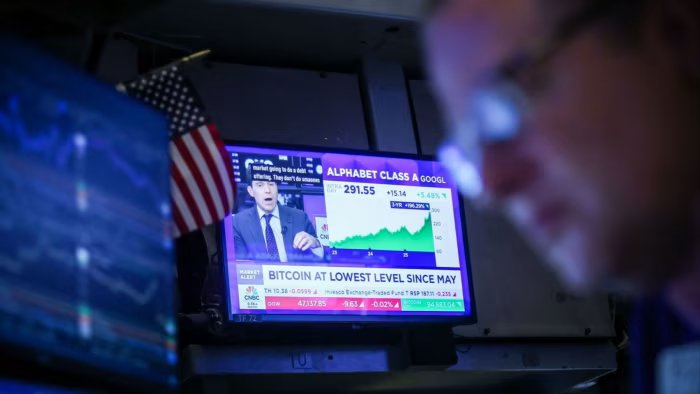
Equally, bitcoin — the bouncing bundle of promise and potential that launched into the world across the identical time as Martin child B — has prior to now week or so really carried out a fairly helpful service. Proponents have instructed me for years that bitcoin is cash (it’s not, actually), that it’s an inflation hedge (come on, now), or that it’s a haven asset for occasions of stress (LOL), nevertheless it seems that its most helpful operate is to function an early warning system that markets are unwell.
On a number of events of late, it has been a lurch decrease in bitcoin that has led a decline in international shares. It sinks, shares comply with. And it has sunk so much, down by a 3rd since early October to $84,000 or so. Solely one other $84,000 to go earlier than it reaches honest worth.
Shares had regained their footing considerably following a shaky begin to the week after strong earnings outcomes from chipmaking behemoth Nvidia on Wednesday. However it was a tumble within the value of bitcoin that soured the temper once more on Thursday, and shares rapidly adopted. The massive beast of crypto is now mainstream traders’ go-to barometer of vibes and speculative exuberance — a genuinely helpful software ultimately.
This might show to be a really worthwhile instrument for traders as we transfer on from the controversy round whether or not we're in a synthetic intelligence funding bubble — most traders I’ve spoken to just lately agree that we're, or on the very least that pullbacks within the coming weeks and months after a spectacular bull run are a near-certainty. Not a crash, essentially, however a correction, possibly a number of of them. As a substitute, the important thing debate is about whether or not and when to get out.

The boring reply is to all the time be diversified, and whereas that's proper, leaning out of huge tech shares does imply you've in all probability sacrificed numerous returns this yr. These courageous souls attempting to time the market face a trickier process. Get out of shares too early, and also you threat dropping out on the final rungs of the ladder. Being early is actually the identical factor as being incorrect.
That is annoying, for one factor, however for the professionals, it's also probably career-limiting. Nobody in fund administration enjoys the dialog with their boss to clarify why they've trailed behind essentially the most fundamental inventory indices by attempting to be too intelligent. As well as, even if you happen to do, by luck or talent, get out in time, determining when to get again in can be a idiot’s errand. Too quickly, and also you lose cash and look fairly silly. Too late and also you miss these large turning factors on the way in which again up, giving up a surprisingly great amount of efficiency within the course of.
At a presentation this week, Mark Haefele, chief funding officer at UBS World Wealth Administration, mirrored on that time. He acknowledges that numerous “glory and hopes” at the moment are baked into the AI commerce, and he’s not “100 per cent certain” it’s going to maintain working. However he chooses to be optimistic, is diversifying to attempt to keep away from extreme reliance on a small clutch of shares, and he’s actually proper that even when this theme does fall over, we may very well be months, even years away from that occuring.
Haefele recounted that in 1999, proper earlier than the crash (not a correction, a correct crash) in dotcom shares, he was working different individuals’s cash and was deeply nervous a few bubble, and mentioned so to purchasers. On the time he was far too bearish. “We felt horrible,” he mentioned. “We had been too early and we seemed like idiots for some time.” He was later vindicated, after all, however not trying like an fool is a vital, typically underrated aspect of how markets and funding actually work.
At Amundi, the Paris-based European asset supervisor, the temper is analogous. Chief funding officer Vincent Mortier mentioned this week that he's involved about pockets of extreme spending on AI know-how and infrastructure. Markets may very well be at a turning level proper now however equally they may decide up once more quickly.
“You realize you might be in a bubble when it bursts,” Mortier mentioned. A giant drop in large tech shares may effectively be a “massacre”, he added. However timing is every part. His reply is to carry on to these shares for now, however to purchase insurance coverage insurance policies in opposition to a downturn. Hedge, don’t promote, is the motto. Sacrificing a bit of efficiency on choices that pay out in a downturn is a much less bitter capsule than promoting profitable shares too early.
Mortier has no allocation to bitcoin however he's watching it unusually carefully, because it serves as a reminder that “timber are usually not rising to the sky”.
A full-on market crash on the finish of this yr or sooner or later in 2026 continues to be a tail threat. Pullbacks and corrections, alternatively, are extremely doubtless. Holding half an eye fixed on the bitcoin value as a gauge of the market temper may simply assist in navigating this very difficult interval.
katie.martin@ft.com