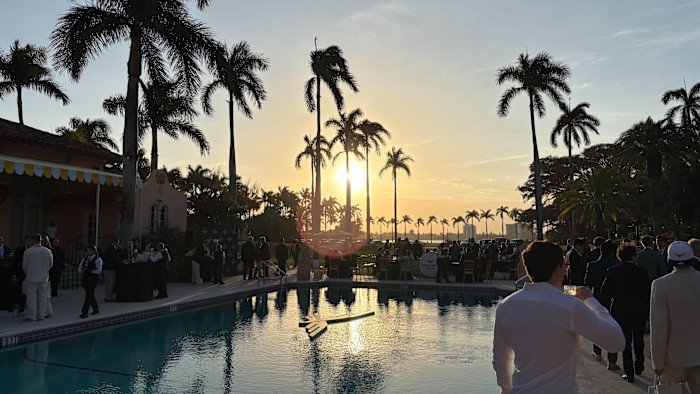
Rapper Nicki Minaj, Fifa president Gianni Infantino and Goldman Sachs chief executive David Solomon on Wednesday walked into Donald Trump’s southern Florida resort.
But this was no joke. Trump’s sons and other associates convened a summit at Mar-a-Lago this week to convince the world’s elite that nearly a year and a half after the 2024 elections, their crypto venture should be viewed as a global power player.
Two US senators, hedge fund manager Philippe Laffont, Franklin Templeton chief executive Jenny Johnson and billionaire Binance founder Changpeng Zhao — the crypto tycoon who was pardoned by Trump last year — were among 400 other dignitaries in attendance at the inaugural conference hosted by World Liberty Financial, the Trump family’s main crypto venture.
Donald Trump Jr, Eric Trump and Zach and Alex Witkoff, the sons of Steve Witkoff, Donald Trump’s special envoy to the Middle East, served as the masters of ceremonies for the jamboree.
“This is retribution,” Eric Trump told his guests from a stage in the resort’s chandelier-laden ballroom, where a huge sculpture of the WLF eagle logo loomed over attendees.
“When we lost the ability to bank, we created World Liberty Financial.”
Some of Wall Street’s biggest lenders “wanted us to crawl into the corner and die”, Donald Trump Jr added. “They created a monster.”

Wednesday’s forum underscored the growing clout of a company that by industry standards is still relatively small. WLF’s dollar-pegged coin USD1 has a market capitalisation of about $5bn while stablecoins operated by its biggest competitors Tether and Circle are valued at $185bn and $73bn, respectively.
The group’s allure has been polished by its connections to the president, whose administration has put crypto at the heart of its financial policies.
Donald Trump and his family have also engaged in crypto ventures beyond WLF. The president launched a “memecoin” before his inauguration last January, while his wife Melania launched her own coin 43 hours later.
The Trump family’s crypto empire reaped roughly $1bn in pre-tax profits in the year to October 2025, the FT has previously reported.

Earlier this month, WLF acknowledged that it had accepted a $500mn investment backed by an Abu Dhabi royal days before Trump’s inauguration last January. The company denied the deal had anything to do with an agreement to grant the United Arab Emirates access to US AI chips later in the year.
Although the president himself did not make an appearance on Wednesday, his presence and influence was abundantly clear. The Mar-a-Lago resort bears the Trump name, gilded on plates, napkins, tiles and even plastic water bottles. A resort gift shop displayed “Trumplican” hats, Trump chocolate and a $40 “Trump 2028” pin available for purchase.
Between coffee breaks and a lunch of assorted meats and boiled vegetables — and shrimp cocktail — speakers on Wednesday largely ignored the sell-off that has gripped bitcoin and other major digital tokens since October.

The impact of AI on US capital markets and the surging popularity of event contracts on sports and political developments came up again and again.
Sporting a bright orange tie, Commodity Futures Trading Commission chair Michael Selig described prediction markets as a “check on our news media”. Republican Senator Bernie Moreno hit out at unidentified “maniacal lunatics” in the Biden administration before Minaj described her “love” for Treasury secretary Scott Bessent.
Infantino had earlier poured forth to a room full of Republicans on soccer’s superiority to American football. Nasdaq chief executive Adena Friedman ended her appearance by recommending Andrew Ross Sorkin’s new book 1929.
“I’m not saying there are any parallels” today, she quickly clarified.

Crypto legislation proved another popular subject. The conference came as traditional banks remain locked in a fierce fight with crypto players such as Coinbase over the details of the Clarity Act.
Coinbase’s Brian Armstrong, also in attendance, became a significant holdout on early drafts of the bill when Wall Street lenders pushed to close what they describe as a “loophole” that they argue would allow crypto groups to offer rewards to customers who hold dollar-pegged stablecoins.
Banks say these rewards will lead to deposit flight. In a building where paintings by 19th-century classicist Alexandre Cabanel hang opposite graphic renderings of Trump’s near-death experience on the campaign trail in 2024, Goldman chief Solomon on Wednesday presented the fight as one for an equal playing field between the old guard and the new.
“If there are people that think we’re going to operate without rules, they’re probably wrong, and they should move to El Salvador,” Solomon said, paraphrasing previous comments by Bessent on the Clarity Act. Later, he said he was at the conference because “Alex [Witkoff] and his family are great clients of the firm”. He exited the conference shortly after departing the stage.

Armstrong, whose firm partners with leading US stablecoin issuer Circle, went on to heap praise on the WLF team.
It was left to WLF co-founder Zak Folkman to explain how the company intends to build on its success. WLF in January applied for a US banking licence that would broaden its access to the traditional financial system. But its plans do not stop there.
There would come a time when retail traders using WLF’s platform would be able to use “tokenised luxury floating villas in the Maldives” as collateral for loans extended by code, Folkman said — and when AI agents would be free to shop on investors’ behalf using WLF’s stablecoin USD1.

“We’re building the entire infrastructure for the future,” he concluded. At the drinks reception by the pool later that night, it was hard to find anyone who did not think WLF was on the right track.