Intro
Ethereum’s scaling has been a hotly debated matter for some time. Layer 2 options have been on the forefront of this battle, providing a method to deal with transactions off the principle chain to alleviate congestion and scale back charges. However there’s a catch. Even L2s face limitations that hinder their effectivity and scalability. EIP-4844 is the following step in growing L2’s potential and aligning Ethereum with its scaling roadmap.
So, what's EIP-4844 all about? How precisely does it assist with scaling L2s? What new potentialities does it unlock? And is it true that it could possibly scale back transaction charges on L2s by over 90%? You will see that solutions to those questions and extra on this publish.
What's EIP-4844 and Proto-danksharding?
As a reminder, EIP stands for Ethereum Enchancment Proposal, a course of by which builders can counsel modifications to the Ethereum protocol. EIP-4844, particularly, proposes a brand new sort of transaction that may considerably improve the best way information is dealt with and processed on Ethereum.
You might need additionally heard the identify “proto-danksharding” which is now used interchangeably with EIP-4844.
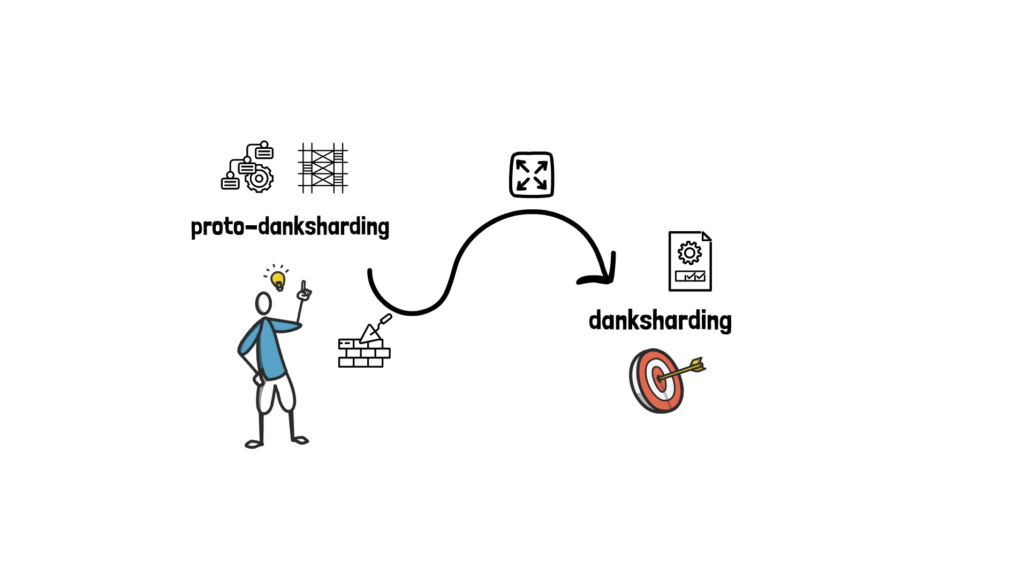
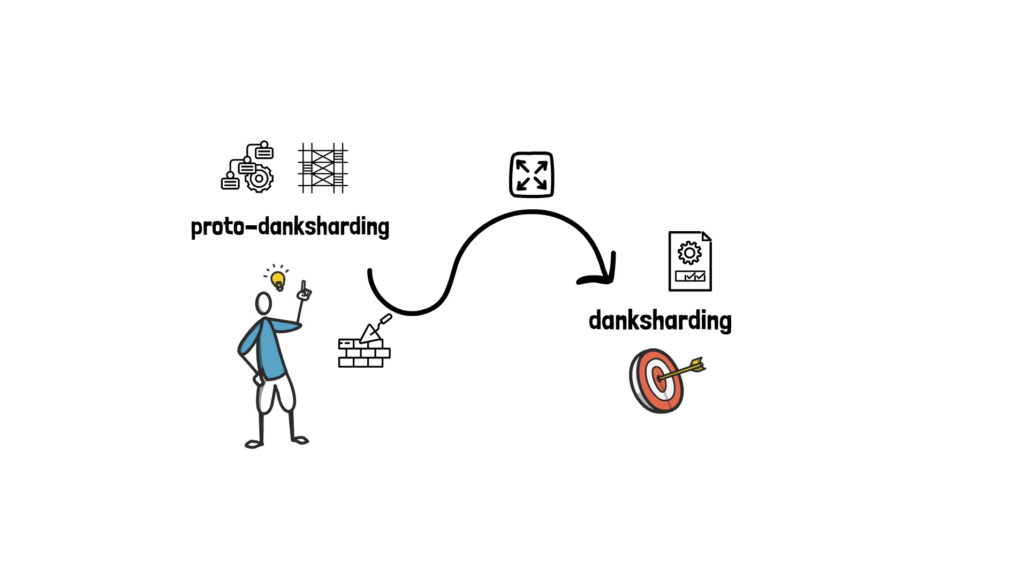
Proto-danksharding is an preliminary implementation of full danksharding. It lays the muse for additional scaling with danksharding sooner or later. That is achieved by implementing many of the logic and “scaffolding” that make up a full danksharding spec, with out implementing the precise information sharding. Doing it this fashion permits for a neater and fewer disruptive transition that may happen over a number of community upgrades with out introducing an excessive amount of threat to Ethereum in a single improve.
The core concept behind EIP-4844 is to assist the ‘rollup-centric’ way forward for Ethereum. Rollups are Layer 2 options that course of transactions exterior the principle Ethereum chain however inherit Ethereum’s safety. EIP-4844 goals to make rollups cheaper and extra environment friendly by introducing a brand new sort of transaction that may be leveraged by rollups to permit them to lower their operational prices by an order of magnitude.
This in flip will enable functions constructed on prime of rollups to be less expensive to make use of and improve the adoption of the entire Ethereum ecosystem.
Think about doing a DEX swap on one of many rollups. If the present price of doing such an operation is, let’s say, $1, it's going to most certainly lower to round $0.10 post-EIP-4844. The affect on this instance has some caveats although that we'll cowl later within the video.
EIP-4844 along with just a few different EIPs will probably be included within the upcoming Dencun community improve.
Now, let’s have a more in-depth have a look at how EIP-4844 works.
Technical Particulars
EIP-4844 introduces a brand new sort of transaction sort to Ethereum which accepts “blobs” of information to be persevered within the beacon node for a brief time period. These modifications are forward-compatible with Ethereum’s scaling roadmap, and blobs are sufficiently small to maintain disk use manageable. Blob transactions are in the identical format wherein they're anticipated to exist within the ultimate danksharding specification.
This comes alongside a ‘blob price market,’ making certain that the “blob” house is used effectively and stays economically viable. That is achieved by introducing blob fuel as a brand new sort of fuel. It's unbiased of regular fuel. For now, solely blobs are priced in blob fuel.
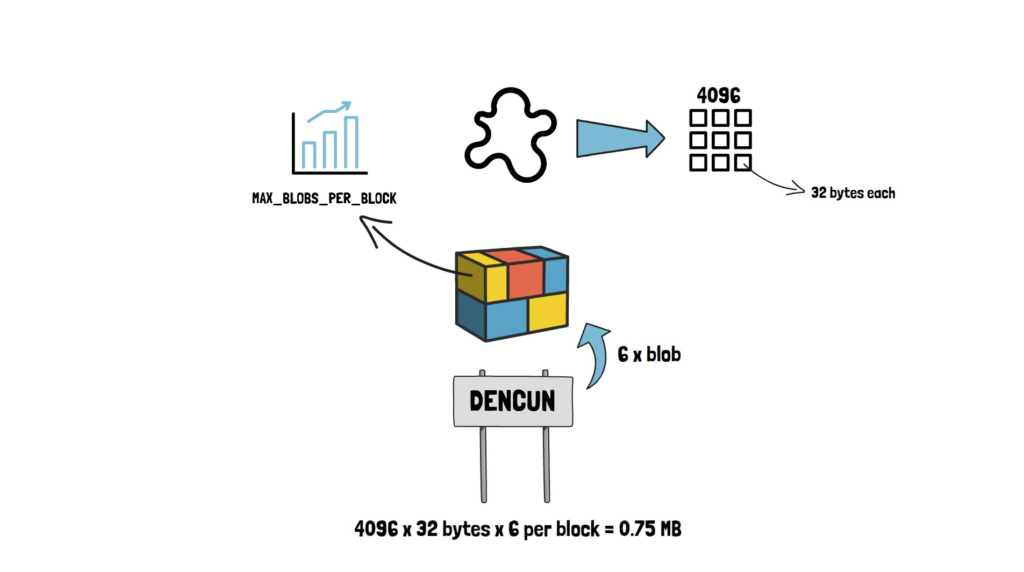
Blobs are 4096 discipline parts of 32 bytes every. The blob cap per block is managed by the MAX_BLOBS_PER_BLOCK parameter. The cap can begin low and develop over a number of community upgrades. Initially, Dencun is focusing on 6 blobs per block. 4096 * 32 bytes * 6 per block = 0.75 MB per block.
Blobs are persevered in beacon nodes (consensus layer), not within the execution layer. Future sharding work solely requires modifications to the beacon node, enabling the execution layer to work on different initiatives in parallel.
Blobs are short-lived and pruned after round 2 weeks. They're accessible lengthy sufficient for all actors of a rollup to retrieve it, however quick sufficient to maintain disk use manageable. This permits blobs to be priced cheaper than CALLDATA, which is information saved in historical past ceaselessly.
The cryptographic spine of EIP-4844 is KZG commitments. With out getting too deep into the weeds, they permit for environment friendly and safe information inclusion, essential for the performance of blob transactions. This manner, solely commitments to “blobs” must be interpreted by the EVM within the execution layer and never the “blobs” themselves.
To generate the shared secret for KZG commitments, a browser-based, broadly distributed ceremony was run so all Ethereum community individuals had an opportunity to make sure it was generated accurately and securely.
EIP-4844 provides a brand new precompile referred to as level analysis that verifies a KZG proof which claims {that a} blob (represented by a dedication) evaluates to a given worth at a given level.
So how precisely does this all apply to rollups?
With the brand new blob house, rollups will be capable to put their block information into blobs relatively than the costlier CALLDATA that has been used for this objective to this point.
Leveraging a short-lived blob house within the consensus layer is feasible as rollups want information to be accessible solely lengthy sufficient to make sure trustworthy actors can assemble the rollup house.
Within the case of optimistic rollups like Optimism or Arbitrum, they solely want to offer the underlying information for so long as the fraud problem window is open. The fraud-proof can confirm the transition in smaller steps, loading at most just a few values of the blob at a time by CALLDATA.
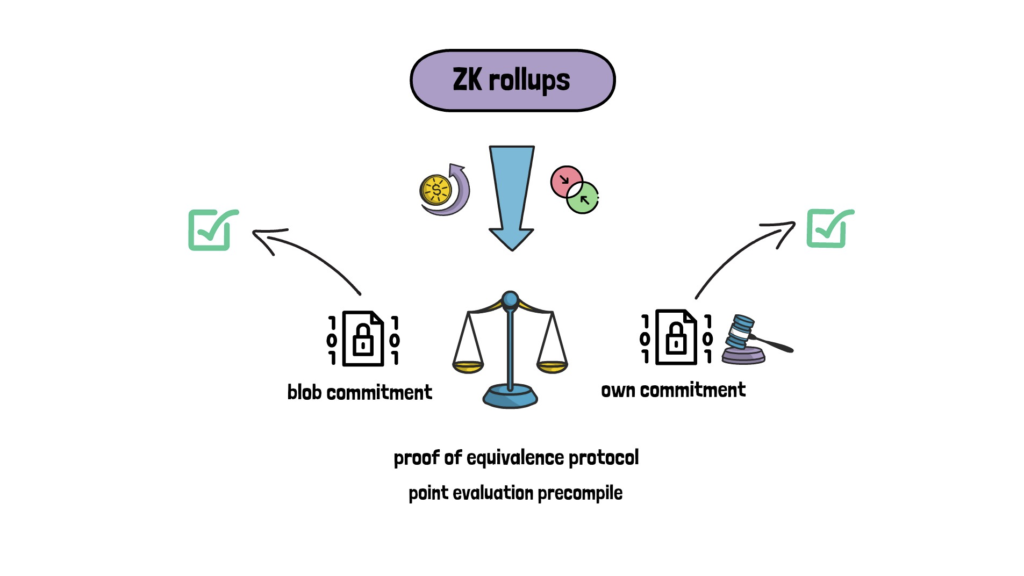
ZK rollups would supply two commitments to their transaction or state delta information: the blob dedication and the ZK rollup’s personal dedication utilizing no matter proof system the rollup makes use of internally. They might additionally use a proof of equivalence protocol, utilizing the beforehand talked about level analysis precompile, to show that the 2 commitments check with the identical information.
Impression
The affect of EIP-4844 on the Ethereum ecosystem can't be overstated. For starters, it dramatically improves the scalability of Layer 2 options, decreasing their operational prices and making them extra aggressive with different, low cost, various blockchains. The discount in operational price is feasible because the overwhelming majority of the fee presently incurred by rollups is as a result of charges paid for CALLDATA.
Furthermore, EIP-4844 lays the groundwork for even additional scaling by full danksharding. This future improve will cut up the Ethereum community into a number of information shards, every able to storing information independently, additional enhancing the community’s capability.
With operational prices coming down, we might witness a wave of latest Layer 2 options rising, attracting builders to construct modern functions on rollups.
In terms of the lower in transaction prices on rollups, illustrated by our earlier DEX swap instance, the scenario is advanced. Assuming the demand for rollups stays fixed post-EIP-4844, we might certainly anticipate a major discount in prices for customers.
Nonetheless, enhancements in scalability can result in unexpected financial results. For example, decrease transaction charges for end-users would possibly drive extra folks to make use of rollups, subsequently growing the demand on community assets and doubtlessly elevating transaction prices.
One factor is for certain, even when the principle result's the rise in transaction throughput and the price of transactions stays the identical, EIP-4844 lays the muse for even larger scalability sooner or later that can ultimately lead to cheaper transactions for the customers.
Abstract
Excitingly, the Ethereum neighborhood has already accomplished testing EIP-4844 on varied testnets, with a mainnet launch anticipated on the thirteenth of March. This can be a monumental step in the direction of attaining unparalleled scalability for Ethereum.
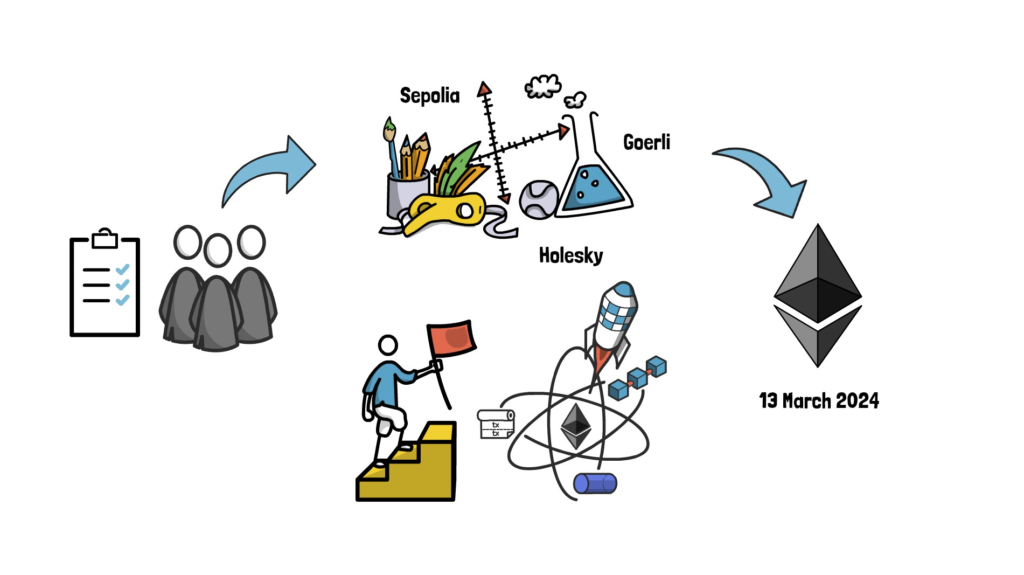
We will already see many of the main L2s committing to begin utilizing the brand new “blob” house as quickly because the Dencun improve occurs.
In conclusion, EIP-4844 is extra than simply an improve. It’s a pivotal second in Ethereum’s journey in the direction of turning into a extra scalable, environment friendly, and user-friendly blockchain. By decreasing the prices and growing the effectivity of Layer 2 options, Ethereum is about to solidify its place because the main platform for decentralized functions.
When you loved studying this publish, try Finematics on Youtube and Twitter.