


[ad_1]
Key Takeaways
-
▸
Polls show a wide-open three-way race, but prediction markets price Abdul El-Sayed as the clear (though slight) favorite. -
▸
Markets appear to factor in momentum indicators like small-dollar fundraising and online engagement that polls don’t fully capture. -
▸
Despite primary uncertainty, markets still strongly favor Democrats to hold the seat.
The Michigan 2026 Democratic Senate race is a textbook case of prediction markets trading a different narrative than the polls. While public surveys still largely show a tight, back-and-forth race between progressive candidate Abdul El‑Sayed, State Sen. Mallory McMorrow and US Rep. Haley Stevens, prediction markets are pricing El‑Sayed as the marginal favorite in the Democratic primary, with the broader Senate race still looking like the Democratic Party can keep the seat of retiring Sen. Gary Peters.
Michigan could be another state where traders are pricing in metrics that conventional polls are not, and helping midterm elections odds be a more accurate forecast of what’s to come in November. Traders appear to be picking up similar queues to those in Maine, where a progressive candidate is outpacing an establishment-backed candidate.
“It’s one of the fundamental draws of prediction markets; to be able to better predict matters of public significance,” said Stephen Piepgrass, a partner at Trout Pepper Locke. “It’s hard to find something with more public significance than elections.”
Michigan polling picture: A wide, messy primary
The latest Emerson College Poll of Michigan Democratic primary voters finds El‑Sayed and McMorrow both at 24%, with Stevens at 13% and a whopping 36% undecided heading into August.
That’s a structurally wide field, with clear generational splits. Voters under 40 tilt strongly to El‑Sayed, while voters over 50 favor McMorrow, and Stevens sits somewhere in the middle.
Those numbers make the primary look like a true three‑way contest, with the undecided group large enough to swing the outcome depending on late‑cycle messaging, money and turnout. Here, the polls are not saying much ahead of the August 4 primary. Essentially, polls say it is an open primary with no clear prohibitive frontrunner.
El‑Sayed favored by prediction markets
By contrast, Polymarket’s Michigan Democratic Senate Primary Winner market currently price El‑Sayed as the clear leader at 52% chance, with McMorrow and Stevens priced lower, at 30% and 14% respectively. The contract already has more than $513K in volume, which means the forecasts are coming from a material pool of active traders, not just a small crowd.
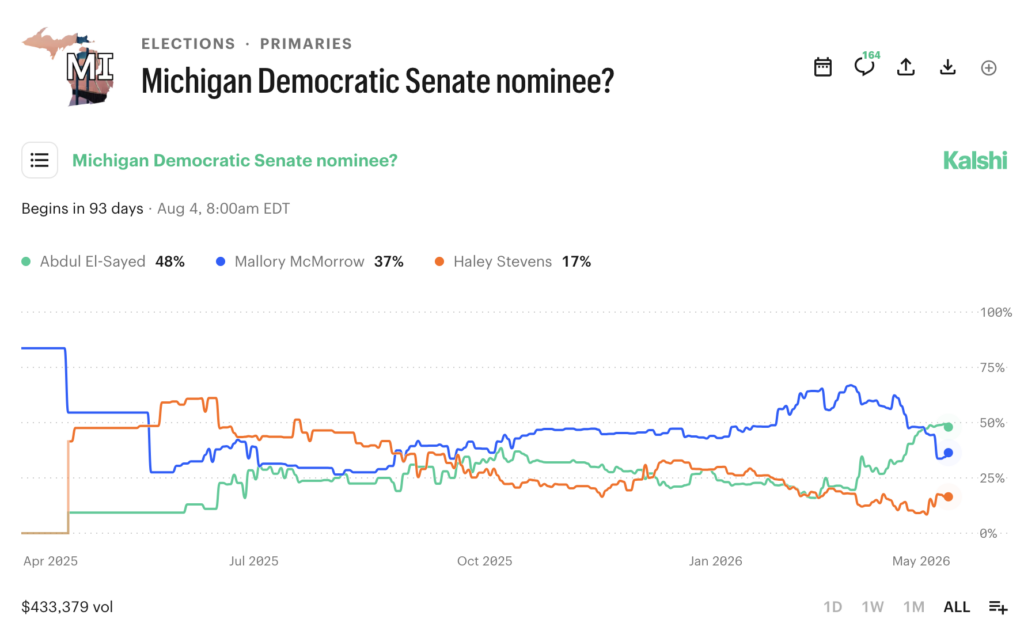
Kalshi’s Michigan Democratic Senate nominee contract is trading roughly the same on $433K in volume. Traders have El-Sayed at 48%, with McMorrow trading at 37% and Stevens trailing at 17%.
Why the divergence matters
The polls suggest it is a multi‑candidate scramble in Michigan, while the traders forecast El‑Sayed as a clear leader. That’s not a wild statistical anomaly. It’s a signal that the market is weighing things like online enthusiasm, small‑dollar fundraising, and social media momentum that don’t always show up cleanly in telephone or mixed‑mode polling.
Those metrics are in line with the ones traders used to forecast the Maine Democratic Senate primary outcome, as Graham Platner now has a clear road ahead after Gov. Janet Mills suspended her campaign.
It also matters for the general election. Polymarket’s Michigan Senate Election Winner contract still prices Democrat at 77% and Republican at 22%, which suggests traders see this race as a safe retention for Democrats, even if the Republican side nominates Mike Rogers, the 2024 runner‑up to Sen. Elissa Slotkin.
The polls show a three‑way logjam, but prediction markets identify one candidate as the slight favorite and the broader race as a Democratic‑leaning seat that will be crucial if the party is to win the Senate back.

Pat Evans
Pat Evans has nearly two decades of experience covering complex industries. Before joining Defi Rate in 2026, he spent more than 15 years writing about sports betting, food and beverage, construction, health care and sports business for national and regional outlets. He previously worked as a reporter and editor for publications including the Grand Rapids Business Journal, Front Office Sports, Legal Sports Report and iGaming Business, where he began in-depth reporting on prediction markets. Pat holds a political science degree from Michigan State University.
[ad_2]
Source link